资讯
Early DLSS 5 Testing Suggests the RTX 5090's Single Power Connector Might Be the Bottleneck
📌 概要
社区用泄露的DLSS 5 DLL通过Optiscaler注入,在RTX 5090 FE与MSI Lightning Z上测试《赛博朋克2077》等三款游戏。结果显示性能瓶颈或非算力,而是FE版单个12V-2x6供电接口限制的功耗上限,测试帧成本与NVIDIA公布的每帧8毫秒数据基本吻合。
⚡ 关键要点
- ▸测试基于NBA 2K27泄露的DLSS 5 DLL,经社区Optiscaler注入,非官方Streamline路径
- ▸在RTX 5090 FE和MSI RTX 5090 Lightning Z上测试了赛博朋克2077、霍格沃茨之遗和控制三款游戏
- ▸结果显示瓶颈可能是供电而非算力,FE版单个12V-2x6接口限制功耗发挥
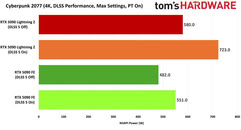
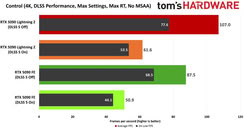
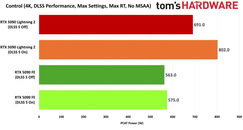
Community testing of leaked DLSS 5 builds suggests the tech may already be hitting a wall on NVIDIA's own flagship GPU. Tom's Hardware ran the neural rendering model through Cyberpunk 2077, Hogwarts Legacy, and Control on an RTX 5090 Founders Edition, as well as an MSI RTX 5090 Lightning Z. Surprisingly, the results point to power delivery as the potential bottleneck rather than compute horsepower. The test used a community Optiscaler injection method built on the leaked DLSS 5 DLL, not NVIDIA's official Streamline path, though the cost lined up closely with NVIDIA's own published 8 ms-per-frame figure.
The Founders Edition, limited to a single 12V-2x6 connector, dropped framerates by 42 to 49 percent with DLSS 5 enabled and consistently hit its 575 W power limit while doing so. The MSI Lightning Z, with a dual-connector setup and a 1000 W limit, took a smaller hit and held better 1% lows, while pulling far more power. In Hogwarts Legacy, it jumped from 480 W to 720 W with neural rendering active, which is a sizeable 50% increase. That leaves single-connector RTX 5090 cards apparently underprovisioned for a feature this demanding, at least unofficially.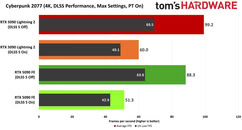
 Read full story
The Founders Edition, limited to a single 12V-2x6 connector, dropped framerates by 42 to 49 percent with DLSS 5 enabled and consistently hit its 575 W power limit while doing so. The MSI Lightning Z, with a dual-connector setup and a 1000 W limit, took a smaller hit and held better 1% lows, while pulling far more power. In Hogwarts Legacy, it jumped from 480 W to 720 W with neural rendering active, which is a sizeable 50% increase. That leaves single-connector RTX 5090 cards apparently underprovisioned for a feature this demanding, at least unofficially.


 Read full story